AI ClaimsRapid review

John Hattie · 2009

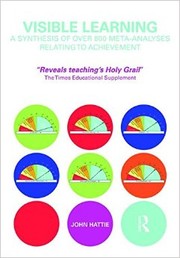
Visible Learning

A Synthesis of Over 800 Meta-Analyses Relating to Achievement

Cover via Open Library

Rough AI truth score

58/100

Hattie's synthesis made educational evidence unusually accessible and correctly emphasizes feedback, clarity, challenge, and attention to impact. Its universal rankings and 0.40 hinge point overstate comparability across outcomes, designs, ages, and subjects; pooled effect sizes are prompts for inquiry, not a league table of what works everywhere.

Based on three central claims · medium-high confidence

The three claims

01Mostly supported

Many influences on achievement can be synthesized through meta-analysis to reveal broad patterns worth testing in educational practice.

Meta-analysis can summarize dispersed evidence and expose heterogeneity, and Hattie's project made a vast literature navigable. A synthesis of syntheses inherits primary-study bias, overlapping samples, construct ambiguity, and inconsistent designs, so its patterns require domain-specific checking.

02Mostly supported

Teachers improve learning when they make goals and success criteria clear, elicit evidence of student understanding, and adapt teaching through feedback.

Formative assessment and feedback have substantial support, but feedback effects are heterogeneous and can be weak or harmful depending on timing, content, goal level, and learner interpretation. The principle is stronger than any single aggregate rank or effect-size estimate.

03Weak

Educational influences can be compared on one common effect-size scale, with 0.40 serving as a meaningful universal hinge point for deciding what works.

Effect sizes depend on outcome scale, study design, comparison condition, duration, age, domain, clustering, and measurement reliability. Combining heterogeneous constructs into a ranked list hides moderators and uncertainty, while average annual growth is not a stable universal treatment threshold.

Other claims worth checking
  • Student self-assessment can be informative when calibrated against external evidence.
  • Effect estimates should begin professional inquiry rather than end it.

What this number means. It is an AI-generated first-pass judgment of three central factual or causal claims—not a rating, exhaustive fact-check, or human peer review. Claim credits are 100% for supported, 75% for mostly supported, 50% for mixed, and 25% for weak, then averaged and rounded. Lower confidence means the score should move more as better evidence arrives.

Method three-central-claims/0.1.0 · checked 2026-09-01 · 3/3 selected claims assessed · method and source audit