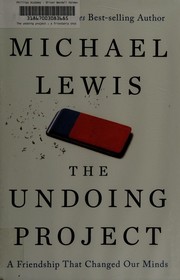
AI ClaimsRapid review

Michael Lewis · 2016

The Undoing Project

A Friendship That Changed Our Minds

Cover via Open Library

Rough AI truth score

67/100

Lewis accurately centers Kahneman and Tversky's collaboration in the rise of heuristics-and-biases research and prospect theory, whose influence across economics, medicine, and policy is undeniable. The scientific legacy is more mixed than a friendship narrative can show: many central effects endure, others have boundary conditions, and neither the partnership's productivity nor its rupture has a single testable interpersonal cause.

Based on three central claims · medium-high confidence

The three claims

01Mostly supported

Kahneman and Tversky established systematic deviations from expected-utility and Bayesian ideals in judgment under uncertainty.

Their experiments on representativeness, availability, anchoring, framing, and risky choice generated reproducible research programs and formal alternatives such as prospect theory. Particular tasks, effect sizes, and interpretations vary, and some apparent errors are sensitive to format, sampling assumptions, or ecological context.

02Mostly supported

Their work materially changed economics, medicine, forecasting, public policy, and the study of decision-making.

Prospect theory, framing, and heuristics became central reference points in behavioral economics and applied decision research, influencing empirical agendas and policy design. Application is uneven, and the existence of an intervention inspired by the work does not prove that it improves welfare in every setting.

03Mixed

The collaborators' personal dynamic is a sufficient causal explanation for both the research program's success and their eventual rupture.

Letters, interviews, and contemporaneous accounts make the partnership's intensity and complementarity historically important, but retrospective narrative selects and arranges ambiguous evidence. Institutional opportunity, collaborators, prior literatures, career incentives, geography, and memory also shaped the work and relationship.

Other claims worth checking
  • Interdisciplinary collaboration helped move psychological evidence into economics.
  • Biographical storytelling can clarify discovery while oversimplifying cumulative science.

What this number means. It is an AI-generated first-pass judgment of three central factual or causal claims—not a rating, exhaustive fact-check, or human peer review. Claim credits are 100% for supported, 75% for mostly supported, 50% for mixed, and 25% for weak, then averaged and rounded. Lower confidence means the score should move more as better evidence arrives.

Method three-central-claims/0.1.0 · checked 2026-09-01 · 3/3 selected claims assessed · method and source audit