AI ClaimsRapid review

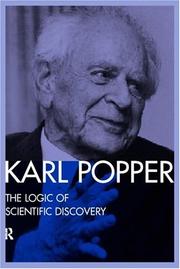
Karl Popper · 1934

The Logic of Scientific Discovery

Cover via Open Library

Rough AI truth score

75/100

Popper's asymmetry between verification and falsification remains a foundational insight, and severe testing is a genuine scientific virtue. The book is weaker as a complete account of practice: observations are theory-laden, tests rely on auxiliary assumptions, and scientists rationally weigh cumulative evidence rather than abandoning a theory after any apparent counterexample.

Based on three central claims · medium-high confidence

The three claims

01Supported

Universal scientific laws cannot be conclusively verified by any finite set of confirming observations, while a genuine counterexample can logically conflict with them.

The deductive asymmetry is sound: no finite collection of observed white swans entails that every swan is white, whereas one well-established nonwhite swan contradicts the universal statement. Real tests remain fallible because observations and background assumptions can be mistaken.

02Mostly supported

Scientific theories should expose themselves to risky empirical tests and be judged partly by how well they survive serious attempts at refutation.

Testability, risky prediction, replication, and error correction are central scientific norms. Confirmation, model comparison, measurement quality, explanatory integration, and probabilistic evidence also matter, so falsification is an important discipline rather than a sufficient algorithm.

03Mixed

Falsifiability provides a comprehensive criterion that cleanly separates science from every form of metaphysics or pseudoscience.

Empirical vulnerability helps distinguish many scientific claims from immunized doctrines. Statistical hypotheses, historical sciences, complex models, auxiliary assumptions, exploratory work, and evolving research programs make a single binary boundary inadequate, while some falsifiable claims are still poor science.

Other claims worth checking
  • Corroboration records survival of tests rather than probability of truth.
  • Induction cannot logically generate or justify universal theories in the way classical accounts proposed.

What this number means. It is an AI-generated first-pass judgment of three central factual or causal claims—not a rating, exhaustive fact-check, or human peer review. Claim credits are 100% for supported, 75% for mostly supported, 50% for mixed, and 25% for weak, then averaged and rounded. Lower confidence means the score should move more as better evidence arrives.

Method three-central-claims/0.1.0 · checked 2026-09-01 · 3/3 selected claims assessed · method and source audit