AI ClaimsRapid review

David McCullough · 1972

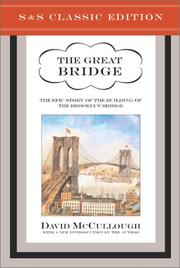
The Great Bridge

The Epic Story of the Building of the Brooklyn Bridge

Cover via Open Library

Rough AI truth score

83/100

McCullough's engineering and family history remains exceptionally sturdy: the bridge's technical audacity, caisson hazards, political setting, and the Roeblings' roles are strongly documented. The bridge became a powerful metropolitan symbol, but it did not single-handedly create consolidated New York.

Based on three central claims · high confidence

The three claims

01Supported

The Brooklyn Bridge was an unprecedented suspension-bridge project whose caissons, cables, towers, and long main span demanded major engineering advances.

New York City and landmark records confirm the 1869–1883 construction, 1,595.5-foot main span, cable-spinning system, and status as the world's longest suspension bridge at opening. McCullough's central engineering narrative aligns closely with the surviving institutional record.

02Supported

Washington Roebling's caisson illness forced Emily Warren Roebling to become the essential link between the disabled chief engineer and the bridge works.

Federal and city histories document Washington's decompression illness and Emily's sustained technical, managerial, and communications role through completion. Titles such as surrogate chief engineer simplify disputed formal authority, but not her indispensable contribution.

03Mixed

Building the bridge by itself fused New York and Brooklyn into the modern metropolis and determined their political consolidation.

The bridge greatly increased cross-river mobility, commerce, and shared metropolitan identity, making it an important precursor to consolidation. Brooklyn remained a separate city until 1898, however, and political annexation, ferries, migration, industry, finance, and other infrastructure were independent causes.

Other claims worth checking
  • Compressed-air work revealed severe occupational-health risks before decompression sickness was understood.
  • The bridge's public meaning grew beyond its transportation function.

What this number means. It is an AI-generated first-pass judgment of three central factual or causal claims—not a rating, exhaustive fact-check, or human peer review. Claim credits are 100% for supported, 75% for mostly supported, 50% for mixed, and 25% for weak, then averaged and rounded. Lower confidence means the score should move more as better evidence arrives.

Method three-central-claims/0.1.0 · checked 2026-09-01 · 3/3 selected claims assessed · method and source audit