AI ClaimsRapid review

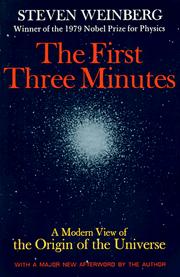
Steven Weinberg · 1977

The First Three Minutes

A Modern View of the Origin of the Universe

Cover via Open Library

Rough AI truth score

83/100

The hot Big Bang, primordial nucleosynthesis, and relic radiation remain core cosmology. Precision has improved dramatically since publication, while the book's earliest-time narrative necessarily reaches beyond directly tested physics.

Based on three central claims · high confidence

The three claims

01Supported

The observable universe evolved from an early hot, dense state and has expanded and cooled for about 13.8 billion years.

Expansion, the cosmic microwave background, light-element abundances, and large-scale structure jointly support hot-Big-Bang cosmology. Planck-era measurements refine the age and parameters without overturning the book's central historical picture.

02Supported

Nuclear reactions in the first minutes produced most cosmic hydrogen and helium plus trace light elements.

Big-bang nucleosynthesis predicts light-element abundances from baryon density and nuclear reaction rates, with broad observational agreement. Lithium remains a notable discrepancy, but it does not erase the successful hydrogen, helium, and deuterium framework.

03Mixed

Known particle physics securely reconstructs conditions all the way back to the universe's first instants.

Tested physics supports much of the thermal history after the earliest epochs, but inflation, baryogenesis, quantum gravity, and initial conditions remain unsettled. Extrapolation becomes increasingly model-dependent far before nucleosynthesis.

Other claims worth checking
  • The cosmic microwave background is relic radiation from the early universe.
  • Cosmology can reconstruct a thermal history without explaining why there is a universe.

What this number means. It is an AI-generated first-pass judgment of three central factual or causal claims—not a rating, exhaustive fact-check, or human peer review. Claim credits are 100% for supported, 75% for mostly supported, 50% for mixed, and 25% for weak, then averaged and rounded. Lower confidence means the score should move more as better evidence arrives.

Method three-central-claims/0.1.0 · checked 2026-09-01 · 3/3 selected claims assessed · method and source audit