AI ClaimsRapid review

Katie Mack · 2020

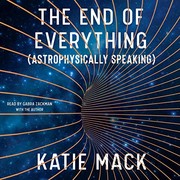
The End of Everything

Astrophysically Speaking

Cover via Open Library

Rough AI truth score

75/100

The candidate endings are legitimate consequences of different physical assumptions, and current acceleration makes long-run cooling the baseline expectation. Dark energy's nature is unknown, so no precise finale can yet be promoted from scenario to forecast.

Based on three central claims · medium-high confidence

The three claims

01Supported

The universe's long-run fate depends strongly on the behavior of dark energy and the expansion history.

Cosmic acceleration is well established, while a cosmological constant, evolving field, or modified gravity can imply different futures. Measuring dark energy's equation of state is therefore directly tied to fate rather than decorative detail.

02Mostly supported

If dark energy behaves like a cosmological constant, continued expansion and a progressively colder, emptier universe are the leading outcome.

Current observations are broadly compatible with a cosmological constant and indefinite acceleration, making heat-death-like dilution the standard baseline. Parameter uncertainty and possible evolving dark energy prevent certainty over immense timescales.

03Mixed

Big Crunch, vacuum decay, Big Rip, and heat death are all physically motivated scenarios rather than equally likely predictions.

Each follows from a defined model or parameter range, so the taxonomy is scientifically meaningful. Evidence currently favors some assumptions over others, vacuum stability depends on uncertain high-energy inputs, and scenario possibility should not be read as comparable probability.

Other claims worth checking
  • Vacuum decay, if possible, would proceed without advance warning.
  • Cosmic endings can be scientifically constrained even when not directly observable.

What this number means. It is an AI-generated first-pass judgment of three central factual or causal claims—not a rating, exhaustive fact-check, or human peer review. Claim credits are 100% for supported, 75% for mostly supported, 50% for mixed, and 25% for weak, then averaged and rounded. Lower confidence means the score should move more as better evidence arrives.

Method three-central-claims/0.1.0 · checked 2026-09-01 · 3/3 selected claims assessed · method and source audit