AI ClaimsRapid review

T. Colin Campbell and Thomas M. Campbell II · 2005

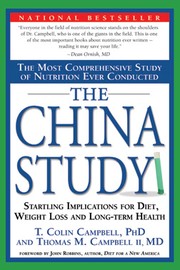
The China Study

The Most Comprehensive Study of Nutrition Ever Conducted

Cover via Open Library

Rough AI truth score

50/100

The book's broad recommendation to eat more minimally processed plant foods aligns with strong dietary guidance. Its strongest claims—that animal protein drives major diseases and that ecological county correlations establish a near-universal whole-food vegan prescription—run well beyond the design and total evidence.

Based on three central claims · medium-low confidence

The three claims

01Mostly supported

Dietary patterns rich in whole plant foods and fiber are associated with lower risks of several chronic diseases.

WHO and IARC recommend fruits, vegetables, legumes, and whole grains as major diet components, with particularly strong evidence for fiber and colorectal health. Benefits reflect substitutions and overall patterns; they do not prove that all animal-source foods must be excluded.

02Mixed

The China-Cornell-Oxford county survey shows that animal-food consumption is a major cause of cancer and other chronic disease.

The survey documented striking geographic variation and generated valuable hypotheses, but it is ecological and cross-sectional, with many correlated exposures and outcomes. County-level associations cannot establish individual causation or isolate animal foods from wealth, infection, smoking, or total diet.

03Weak

Animal protein, especially casein, broadly turns cancer growth on, while a whole-food vegan diet prevents or reverses most major diseases.

Animal and mechanistic studies can generate hypotheses, and some plant-rich interventions improve risk factors. Human evidence does not support casein as a general cancer switch or a single vegan diet as a proven reversal for most diseases; effects differ by food, dose, outcome, and treatment context.

Other claims worth checking
  • Nutrition policy has been distorted by industry influence.
  • Dietary reductionism can hide whole-pattern effects.

What this number means. It is an AI-generated first-pass judgment of three central factual or causal claims—not a rating, exhaustive fact-check, or human peer review. Claim credits are 100% for supported, 75% for mostly supported, 50% for mixed, and 25% for weak, then averaged and rounded. Lower confidence means the score should move more as better evidence arrives.

Method three-central-claims/0.1.0 · checked 2026-09-01 · 3/3 selected claims assessed · method and source audit