AI ClaimsRapid review

Daniel Kahneman, Olivier Sibony, and Cass R. Sunstein · 2021

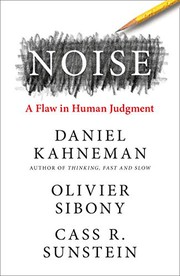
Noise

A Flaw in Human Judgment

Cover via Open Library

Rough AI truth score

67/100

Unwanted disagreement among professionals is real and often consequential, and structured rules, aggregation, independent inputs, and audits can reduce it. The book's broad presumption against variance needs qualification. Some disagreement reflects legitimate values, private information, adaptive expertise, heterogeneous cases, or correlated model error; lower variance does not guarantee lower total error.

Based on three central claims · medium-high confidence

The three claims

01Mostly supported

Professionals making nominally identical judgments show substantial unwanted variability across judges and occasions.

Research in sentencing, medicine, insurance, forecasting, hiring, and expert judgment documents between-judge and within-judge variation after observable case factors. Estimates depend on case comparability, outcome definition, missing information, and whether disagreement reflects error or legitimate discretion.

02Mostly supported

Aggregation, structured rules, independent judgments, and decision hygiene can reduce error from noise.

Averaging independent estimates reduces idiosyncratic error, while checklists, algorithms, decomposition, and delayed discussion can improve consistency and sometimes accuracy. Benefits shrink with shared bias or correlated error, and rigid rules can omit context or shift error into measurement and implementation.

03Mixed

Reducing variance is generally beneficial even where justified discretion, heterogeneity, adaptation, or correlated error matters.

When cases and goals are genuinely equivalent, arbitrary dispersion violates consistency and often fairness. Variance reduction can entrench a biased mean, suppress exploration, erase legitimate plural values, or create brittle uniformity; total error and institutional objectives matter more than variance alone.

Other claims worth checking
  • Noise audits can estimate hidden disagreement using common cases.
  • Sequencing independent estimates before discussion can preserve useful diversity.

What this number means. It is an AI-generated first-pass judgment of three central factual or causal claims—not a rating, exhaustive fact-check, or human peer review. Claim credits are 100% for supported, 75% for mostly supported, 50% for mixed, and 25% for weak, then averaged and rounded. Lower confidence means the score should move more as better evidence arrives.

Method three-central-claims/0.1.0 · checked 2026-09-01 · 3/3 selected claims assessed · method and source audit