AI ClaimsRapid review

Peter C. Brown, Henry L. Roediger III, and Mark A. McDaniel · 2014

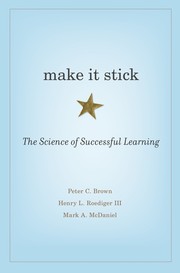
Make It Stick

The Science of Successful Learning

Cover via Open Library

Rough AI truth score

92/100

The book's three central prescriptions are strongly supported: retrieve rather than reread, space practice, and mix or vary practice when discrimination matters. Its popular examples sometimes outrun classroom evidence, but the mechanisms are among the most replicated findings in cognitive psychology.

Based on three central claims · high confidence

The three claims

01Supported

Actively retrieving knowledge strengthens long-term retention more reliably than repeated rereading or passive review.

Controlled experiments and reviews repeatedly find that retrieval practice improves delayed retention, especially with feedback and successful recall. Benefits vary by material and test, and poorly designed quizzing can add anxiety, but the central testing effect is robust.

02Supported

Spacing study and returning to material after some forgetting produces more durable learning than massing the same practice in one session.

A large quantitative literature supports distributed practice across materials, ages, and retention intervals. The optimal gap depends on the desired retention period and task, so spacing is a robust principle rather than one fixed schedule.

03Mostly supported

Interleaving different problem types or examples can improve later discrimination and transfer even when blocked practice feels easier.

Interleaving often improves category learning and problem selection by forcing learners to discriminate among strategies. Effects are task-dependent, can impose excessive difficulty before basics are established, and are less uniform than retrieval and spacing evidence.

Other claims worth checking
  • Fluency during study is a poor proxy for durable mastery.
  • Desirable difficulties help only when they remain achievable and receive useful feedback.

What this number means. It is an AI-generated first-pass judgment of three central factual or causal claims—not a rating, exhaustive fact-check, or human peer review. Claim credits are 100% for supported, 75% for mostly supported, 50% for mixed, and 25% for weak, then averaged and rounded. Lower confidence means the score should move more as better evidence arrives.

Method three-central-claims/0.1.0 · checked 2026-09-01 · 3/3 selected claims assessed · method and source audit