AI ClaimsRapid review

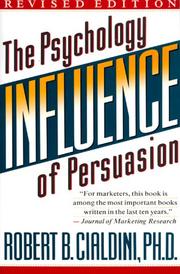
Robert B. Cialdini · 1983

Influence

The Psychology of Persuasion

Cover via Open Library

Rough AI truth score

67/100

Cialdini's core mechanisms are real: reciprocity, social proof, authority, commitment, liking, and scarcity can change compliance and valuation. The book is best read as a practical taxonomy of recurring influence cues, not a set of universal buttons. Effects depend on culture, motive, product, relationship, target awareness, and how each principle is operationalized.

Based on three central claims · medium-high confidence

The three claims

01Mostly supported

Reciprocity, commitment, social proof, liking, authority, and scarcity can causally influence compliance or valuation.

Experiments and meta-analyses support each broad family of influence, including reciprocity, conformity, obedience, and scarcity effects. The six labels aggregate distinct mechanisms and heterogeneous manipulations, and some classic demonstrations have narrow populations or contested interpretations.

02Mostly supported

Influence effects depend on context, culture, motive, relationship, and the target's awareness.

Cross-cultural experiments and moderator analyses show that commitment, social proof, scarcity, and authority do not operate with fixed strength. Source legitimacy, group identity, demand versus supply scarcity, involvement, and defensive motives can amplify, reverse, or suppress an effect.

03Mixed

The six principles form a comprehensive and reliably portable taxonomy for predicting persuasion in most settings.

The framework is memorable and covers many recurring cues, but categories overlap, omit message content and relationship dynamics, and do not specify effect sizes or boundary conditions. Modern syntheses find substantial heterogeneity even within one principle, so a cue's presence is not a reliable forecast by itself.

Other claims worth checking
  • Commitment cues work partly through consistency motives and self-presentation.
  • Similarity and genuine liking can increase receptiveness without guaranteeing agreement.

What this number means. It is an AI-generated first-pass judgment of three central factual or causal claims—not a rating, exhaustive fact-check, or human peer review. Claim credits are 100% for supported, 75% for mostly supported, 50% for mixed, and 25% for weak, then averaged and rounded. Lower confidence means the score should move more as better evidence arrives.

Method three-central-claims/0.1.0 · checked 2026-09-01 · 3/3 selected claims assessed · method and source audit