AI ClaimsRapid review

David Eagleman · 2011

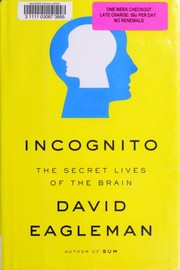
Incognito

The Secret Lives of the Brain

Cover via Open Library

Rough AI truth score

67/100

The book correctly emphasizes that much perception and action occurs without introspective access. Its strongest claims about conscious control, free will, and legal responsibility run beyond what readiness-potential experiments or demonstrations of unconscious processing can establish.

Based on three central claims · medium confidence

The three claims

01Supported

A large share of perception, valuation, and action preparation occurs without conscious access.

Implicit perception, autonomic valuation, motor preparation, and learned biases all have substantial empirical support. Conscious report is neither a complete inventory of processing nor a reliable readout of every causal contribution to behavior.

02Mostly supported

Conscious experience is a constructed summary rather than direct access to the brain's full operations.

Work on predictive processing, interoception, perception, and metacognitive limits supports an active, selective construction of experience. Competing theories remain unresolved, so this framework is productive evidence-backed science rather than a completed explanation of consciousness.

03Weak

Readiness-potential findings show that free will is illusory and straightforwardly justify a biologically calibrated justice system.

Libet-style timing effects are heterogeneous and their key free-will measure rests on few studies with substantial uncertainty. Contemporary accounts treat the readiness potential as compatible with stochastic accumulation or later commitment, and neuroscience alone cannot determine legal norms.

Other claims worth checking
  • The brain contains competing systems rather than a single executive.
  • Legal responsibility should respond to biological differences without abandoning accountability.

What this number means. It is an AI-generated first-pass judgment of three central factual or causal claims—not a rating, exhaustive fact-check, or human peer review. Claim credits are 100% for supported, 75% for mostly supported, 50% for mixed, and 25% for weak, then averaged and rounded. Lower confidence means the score should move more as better evidence arrives.

Method three-central-claims/0.1.0 · checked 2026-09-01 · 3/3 selected claims assessed · method and source audit