AI ClaimsRapid review

Joe Studwell · 2013

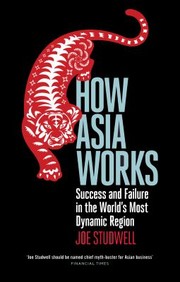
How Asia Works

Success and Failure in the World's Most Dynamic Region

Cover via Open Library

Rough AI truth score

75/100

Studwell's three-part account—smallholder land reform, export-disciplined industrial policy, and controlled finance—captures important commonalities in northeast Asian development. Each component has credible support, but timing, geopolitics, institutions, demographics, and country exceptions limit a universal recipe.

Based on three central claims · medium-high confidence

The three claims

01Mostly supported

Broad smallholder land reform raised rural productivity and created a foundation for industrialization in successful northeast Asian economies.

Japan, South Korea, and Taiwan underwent redistributive reforms followed by large agricultural and rural-income gains, supporting the broad sequence. Recent causal work questions how much specific productivity growth came from ownership change versus technology, infrastructure, prices, and prior trends.

02Mostly supported

Infant-industry protection succeeded when governments forced manufacturers to prove competitiveness through exports.

Japan, Korea, and Taiwan used targeted credit, protection, and export performance pressure rather than simple free trade, and manufacturing learning drove structural change. Selection, discipline, geopolitical support, capable bureaucracy, and eventual competition were crucial; protection without them often entrenched inefficient firms.

03Mostly supported

Financial repression and state-directed credit were necessary to sustain agricultural upgrading and export-disciplined industrialization.

Developmental states directed subsidized capital toward strategic producers and limited speculative allocation, supporting coordinated investment. Directed credit also produced corruption and bad loans, and successful liberalization paths differ, so the evidence supports conditional sequencing rather than permanent control.

Other claims worth checking
  • Southeast Asian economies applied the three disciplines less consistently.
  • Services-led growth is a weak substitute at early development stages.

What this number means. It is an AI-generated first-pass judgment of three central factual or causal claims—not a rating, exhaustive fact-check, or human peer review. Claim credits are 100% for supported, 75% for mostly supported, 50% for mixed, and 25% for weak, then averaged and rounded. Lower confidence means the score should move more as better evidence arrives.

Method three-central-claims/0.1.0 · checked 2026-09-01 · 3/3 selected claims assessed · method and source audit