AI ClaimsRapid review

Anthony Lewis · 1964

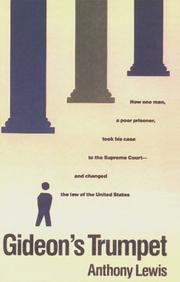
Gideon's Trumpet

Cover via Open Library

Rough AI truth score

83/100

Lewis's account accurately captures how one prisoner's petition became a unanimous constitutional transformation: states must provide counsel to indigent felony defendants because an adversarial trial is not fair without legal assistance. The right on paper was foundational, but chronic defender underfunding means access to a lawyer has not guaranteed equal or effective representation.

Based on three central claims · high confidence

The three claims

01Supported

Gideon v. Wainwright held that states must provide counsel to indigent defendants charged with felonies because counsel is fundamental to a fair trial.

The unanimous 1963 opinion expressly overruled Betts v. Brady and applied the Sixth Amendment right through the Fourteenth Amendment. Later doctrine expanded appointed counsel to misdemeanor cases involving actual imprisonment, while preserving limits and waiver rules.

02Supported

A lay defendant ordinarily cannot navigate an adversarial criminal trial fairly without the guiding hand of trained counsel.

Investigation, evidence, objections, negotiation, defenses, sentencing, and appellate preservation require specialized knowledge, and the Gideon opinion grounded the right in this practical asymmetry. Representation quality differs, but the adversarial system's dependence on counsel is firmly established in law and practice.

03Mixed

The constitutional right to appointed counsel delivered substantially equal and effective representation to poor defendants across the United States.

Gideon created an indispensable entitlement and built statewide defender systems, but caseloads, funding, independence, investigation, plea pressure, and local variation leave large implementation gaps. Appointment alone therefore does not show that representation is timely, conflict-free, adequately resourced, or effective.

Other claims worth checking
  • Individual handwritten petitions can expose structural constitutional problems.
  • Appellate advocacy translated Gideon's experience into a rule applicable nationwide.

What this number means. It is an AI-generated first-pass judgment of three central factual or causal claims—not a rating, exhaustive fact-check, or human peer review. Claim credits are 100% for supported, 75% for mostly supported, 50% for mixed, and 25% for weak, then averaged and rounded. Lower confidence means the score should move more as better evidence arrives.

Method three-central-claims/0.1.0 · checked 2026-09-01 · 3/3 selected claims assessed · method and source audit