AI ClaimsRapid review

Antonio Damasio · 1994

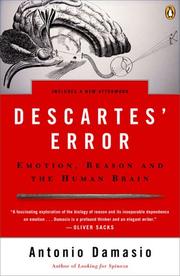
Descartes' Error

Emotion, Reason, and the Human Brain

Cover via Open Library

Rough AI truth score

75/100

Neurological and experimental evidence strongly supports integration of emotion, bodily state, memory, and reasoning. The somatic-marker hypothesis remains influential but is one mechanistic account among several, and the Iowa Gambling Task does not uniquely prove unconscious bodily signals drive advantageous choice.

Based on three central claims · medium-high confidence

The three claims

01Supported

Effective real-world reasoning depends on interaction between emotion, memory, bodily regulation, and cognition.

Patients with ventromedial prefrontal or amygdala damage can retain many formal abilities while showing impaired valuation and choice. Contemporary decision neuroscience broadly rejects a clean opposition between rational cognition and emotion.

02Mostly supported

Ventromedial prefrontal and amygdala systems help attach bodily and emotional value to possible outcomes.

Lesion, autonomic, and task evidence supports these regions in valuation and outcome learning. Their functions sit within distributed networks, and bodily responses are neither necessary nor sufficient in the same way for every decision.

03Mixed

Anticipatory bodily signals in the Iowa Gambling Task uniquely establish the somatic-marker mechanism before conscious knowledge.

The task supports interaction among affect, learning, working memory, and valuation, but participants may acquire usable knowledge earlier than initial reports suggested. Competing accounts and task heterogeneity prevent the classic result from uniquely proving one preconscious somatic mechanism.

Other claims worth checking
  • The mind-body split is a poor model of biological decision-making.
  • Feelings arise from representations of changing body states.

What this number means. It is an AI-generated first-pass judgment of three central factual or causal claims—not a rating, exhaustive fact-check, or human peer review. Claim credits are 100% for supported, 75% for mostly supported, 50% for mixed, and 25% for weak, then averaged and rounded. Lower confidence means the score should move more as better evidence arrives.

Method three-central-claims/0.1.0 · checked 2026-09-01 · 3/3 selected claims assessed · method and source audit