AI ClaimsRapid review

Kip S. Thorne · 1994

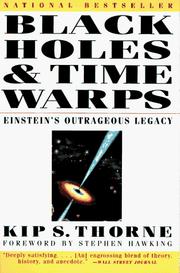
Black Holes and Time Warps

Einstein's Outrageous Legacy

Cover via Open Library

Rough AI truth score

92/100

The book's account of relativity, stellar collapse, black holes, and gravitational waves has been spectacularly vindicated by LIGO and horizon-scale imaging. Its historical interpretation is well researched but necessarily less mechanically testable than the physics.

Based on three central claims · high confidence

The three claims

01Supported

Massive compact objects described by general relativity form black holes with horizons and strong-field spacetime effects.

Stellar and galactic-center observations, gravitational waves, and horizon-scale images match black-hole predictions across very different mass ranges. Measurements constrain alternatives without proving every idealized property of exact solutions.

02Supported

Merging black holes emit gravitational waves with waveforms predicted by general relativity.

GW150914 directly detected the inspiral, merger, and ringdown of a binary-black-hole system, followed by a large catalog of detections. Observed waveforms have repeatedly agreed with relativistic models within measured precision.

03Mostly supported

Scientific progress on black holes emerged through a contingent interaction of theory, instruments, institutions, and individual judgment.

The historical record supports long delays between mathematical solutions, physical acceptance, astrophysical evidence, and detection technology. Particular motives and counterfactual credit remain interpretive, but the institutional and technical sequence is well documented.

Other claims worth checking
  • Wormholes are permitted by some equations but not established as traversable structures.
  • Frame dragging around rotating masses is a measurable relativistic effect.

What this number means. It is an AI-generated first-pass judgment of three central factual or causal claims—not a rating, exhaustive fact-check, or human peer review. Claim credits are 100% for supported, 75% for mostly supported, 50% for mixed, and 25% for weak, then averaged and rounded. Lower confidence means the score should move more as better evidence arrives.

Method three-central-claims/0.1.0 · checked 2026-09-01 · 3/3 selected claims assessed · method and source audit