AI ClaimsRapid review

Robert M. Sapolsky · 2017

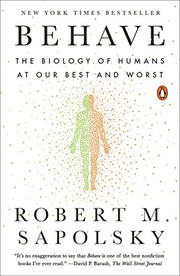
Behave

The Biology of Humans at Our Best and Worst

Cover via Open Library

Rough AI truth score

58/100

The book's layered account of behavior—from seconds of neural activity through hormones, development, culture, and evolution—is scientifically responsible in spirit and often well sourced. The main caveat is translation: many vivid studies are correlational, small, animal-based, or context-dependent, and the synthesis can make unsettled mechanisms seem more unified than the evidence warrants.

Based on three central claims · medium confidence

The three claims

01Mostly supported

Human behavior is produced by interacting biological, developmental, situational, and cultural causes rather than a single level of explanation.

Behavioral neuroscience supports multi-level causation and reciprocal influences among neural systems, endocrine states, development, learning, and social context. Integrating levels is essential, though causal weights are difficult to identify and vary sharply by behavior.

02Mostly supported

Context can rapidly shift aggression, empathy, hierarchy, and moral judgment through identifiable neural and hormonal pathways.

Experimental and observational research links context-sensitive neural and endocrine processes to social behavior. Effects are probabilistic, bidirectional, moderated by learning and culture, and often smaller or less specific than popular hormone narratives imply.

03Weak

Current biology offers a sufficiently integrated causal account to explain most morally important human behavior.

Biology constrains every behavior, but mechanistic explanations of complex moral action remain incomplete. Measurement, reverse inference, replication, cultural variation, institutions, and emergent group dynamics limit how far current findings support a unified causal account.

Other claims worth checking
  • Stress effects depend strongly on timing, duration, controllability, and prior experience.
  • Biological explanation does not by itself settle moral responsibility.

What this number means. It is an AI-generated first-pass judgment of three central factual or causal claims—not a rating, exhaustive fact-check, or human peer review. Claim credits are 100% for supported, 75% for mostly supported, 50% for mixed, and 25% for weak, then averaged and rounded. Lower confidence means the score should move more as better evidence arrives.

Method three-central-claims/0.1.0 · checked 2026-09-01 · 3/3 selected claims assessed · method and source audit